FTDNA released an update to their population finder tool. My old percentage was 90% Orcadian and 10 % Mediterranean.
My new percentage is, 100 Percent European.
If I click on the + symbol next to European, I can expand this to four different reference populations.
My population breakdown is:
56% European Coastal Islands
European Coastal
Islands is typical to the British Isles, especially Ireland. Its reach
includes all European Islands from the far north and down south to the
Azores Islands off the coast of Spain. The continuous mixing of European
populations means that this group is also present in lesser amounts on
the mainland. Genetically close to European Coastal Plain and European
Northlands, European Coastal Islands has had an impact on the demography
of the world because of the explosion of population in the Anglosphere
over the past few centuries.
The farmers came to Britain late,
but when they came they brought great change. The hunters were
assimilated by the farmer. This admixture caused the European Coastal
Islands as we know it to become a hybrid of farmer and hunter. Perhaps
due to its isolation and strategic placement, the major powers in the
world and throughout history have wanted to rule the islands. From
Caesar to the Irish king Niall of the Nine Hostages, we see the wide
variety of genetic influence from the Celts, Picts, Vikings, Normans and
French.
29% European Coastal Plain
The European Coastal
Plain combines nearly all of the threads of European genetic history
into one. This cluster goes from the Bay of Biscay near Spain, toward
the Pripet Marshes of western Russia, to the coastal plain of Northern
Europe. The hunter-gatherer, farmer, and intruder from the steppes were
forged together as one people. The French and the German were created by
the intersection between the civilized and the barbarian during
antiquity. With this diverse ancestry across the uniform plain, a
relatively unified cluster was born.
European Coastal Plain
represents the diverse groups brought together over the past 5,000
years, as Germans, Celts, and Slavs have moved in with their cattle, and
the Romans brought their mills and cities. This cluster is common among
many populations with Northern European heritage. Germanic migrations
after the fall of Rome guaranteed its presence in the south. The people
on the European Coastal Plain are at the heart of recent history. Being
the engines behind the Great Powers of the age, they became the dominant
actors in colonization of the world.
8% North Mediterranean
The North Mediterranean
cluster is a distinct European cluster. It is situated in the southwest
of Europe from Spain to Greece. Its people are a mix of the first
hunter-gatherers to reach Europe and later migrations from Western
Eurasia. There were two waves into the area: first the farmers of the
Middle East and later the Roman Empire.
A long history of
traveling merchants and seafarers shaped this group. The great empires
of Rome and Greece brought it to distant lands. They also brought a
second wave of Western Eurasian influence into the cluster. Its modern
geography speaks to the history of those who moved, either willingly or
in chains, under the Roman Empire. Because of this, the cluster’s
signature is strongest in the western part of the Mediterranean. It is
particularly strong on the isolated island of Sardinia. It reaches
upwards to the British Islands, as well as east into modern Turkey.
They
have the same genetic origin as those who reached north to what is now
Sweden. While the culture survived there, the genetic signature was
largely replaced by later migrations.
7% North Circumpolar
The world is not such a
wide place at the top and the bottom. The North Circumpolar cluster
began around the arctic as hunter-gatherer peoples. They have carried
their genes down to the modern era. The North Circumpolar stretches from
Lappland east to Greenland. Though genetically diverse, the root of
many of these populations is a genetic signature found most often in
Finnic peoples.
These are the descendants of hunter-gatherers who
withstood the push of the farmers. They adapted, and flourished, in a
new age. Like the Bering Expansion, this cluster goes beyond
conventional divisions, and has clear connections with both east and
west. Even the New World is connected to North Circumpolar due to their
shared kinship with ancient Siberia.
Humans pushed into the deep
north only within the last 30,000 years, going where no Neanderthal had
dared. With connections to populations in the south, the northerners
maintained long term lateral connections and developed a coherence as
the ice retreated. North Circumpolar has its roots with Saami hunters
and fishers, as well as Uralic, Russian, Swedish, and even Scandinavian
ancestries.
Overall I'm quite pleased with the new product since it is an update to an existing product that I purchased several years ago.This is a good example of a DNA test providing results for a long time. This test matches my known ancestry from genealogy.
More info here: https://www.familytreedna.com/learn/ftdna/myorigins-population-clusters/
Jeremiah Allen Bastrop County Tax Assessments
Here are various Tax assessments from Bastrop County from 1850-1870 for my 4th Great Grandfather Jeremiah Allen.
1940 United States Census
The 1940 Census is becoming searchable slowly. I'll post any family related images I find here.
1. Minnie Lee Tanner (Scott)
Some of the info on the Census below:
Name: Minnie L Tanner
Titles & Terms:
Event: Census
Event Year: 1940
Event Place: Election Precinct 6, Polk, Florida, United States
Gender: Female
Age: 65
Marital Status: Widowed
Race (Original): White
Race (Standardized): White
Relationship to Head of Household (Original): Mother-in-law
Relationship to Head of Household (Standardized): Mother-in-law
Birthplace: Georgia
Estimated Birth Year: 1875
Residence in 1935: Same Place
Enumeration District Number: 53-13
Family Number: 104
Sheet Number and Letter: 6B
Line Number: 52
NARA Publication Number: T627
NARA Roll Number: 612
Digital Folder Number: 005449603
Image Number: 00542
2. Annie and Homer Sapp
1. Minnie Lee Tanner (Scott)
Some of the info on the Census below:
Name: Minnie L Tanner
Titles & Terms:
Event: Census
Event Year: 1940
Event Place: Election Precinct 6, Polk, Florida, United States
Gender: Female
Age: 65
Marital Status: Widowed
Race (Original): White
Race (Standardized): White
Relationship to Head of Household (Original): Mother-in-law
Relationship to Head of Household (Standardized): Mother-in-law
Birthplace: Georgia
Estimated Birth Year: 1875
Residence in 1935: Same Place
Enumeration District Number: 53-13
Family Number: 104
Sheet Number and Letter: 6B
Line Number: 52
NARA Publication Number: T627
NARA Roll Number: 612
Digital Folder Number: 005449603
Image Number: 00542
2. Annie and Homer Sapp
Juanita Brady State of Florida marriage and divorce records
My grandmother Juanita Brady was married at age 15 to a man named Ollin Rowell. They divorced a few years later and she married my Grandfather Roger Tanner. Below are the documents I received today from the state of Florida.
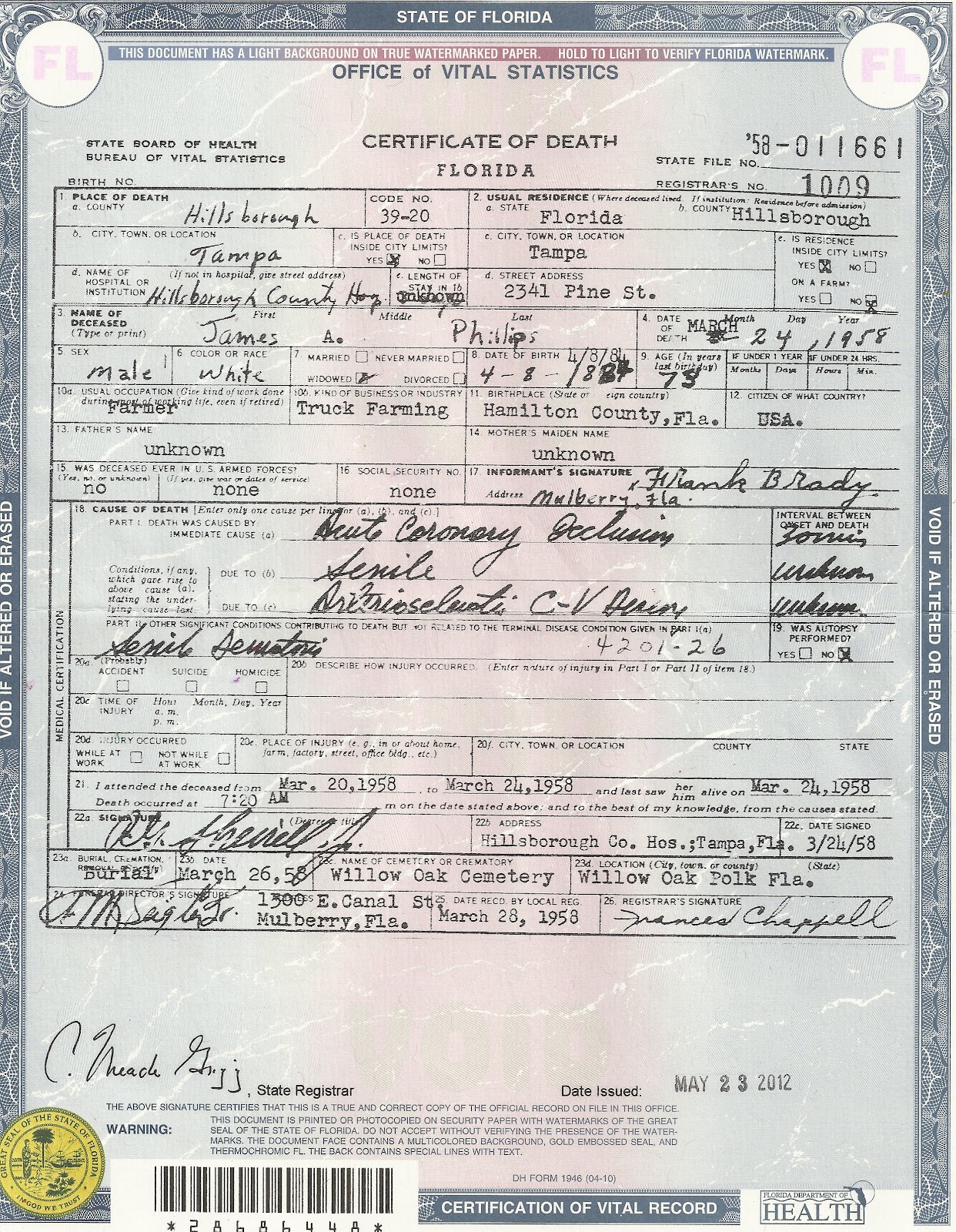
Willow Oak Cemetery
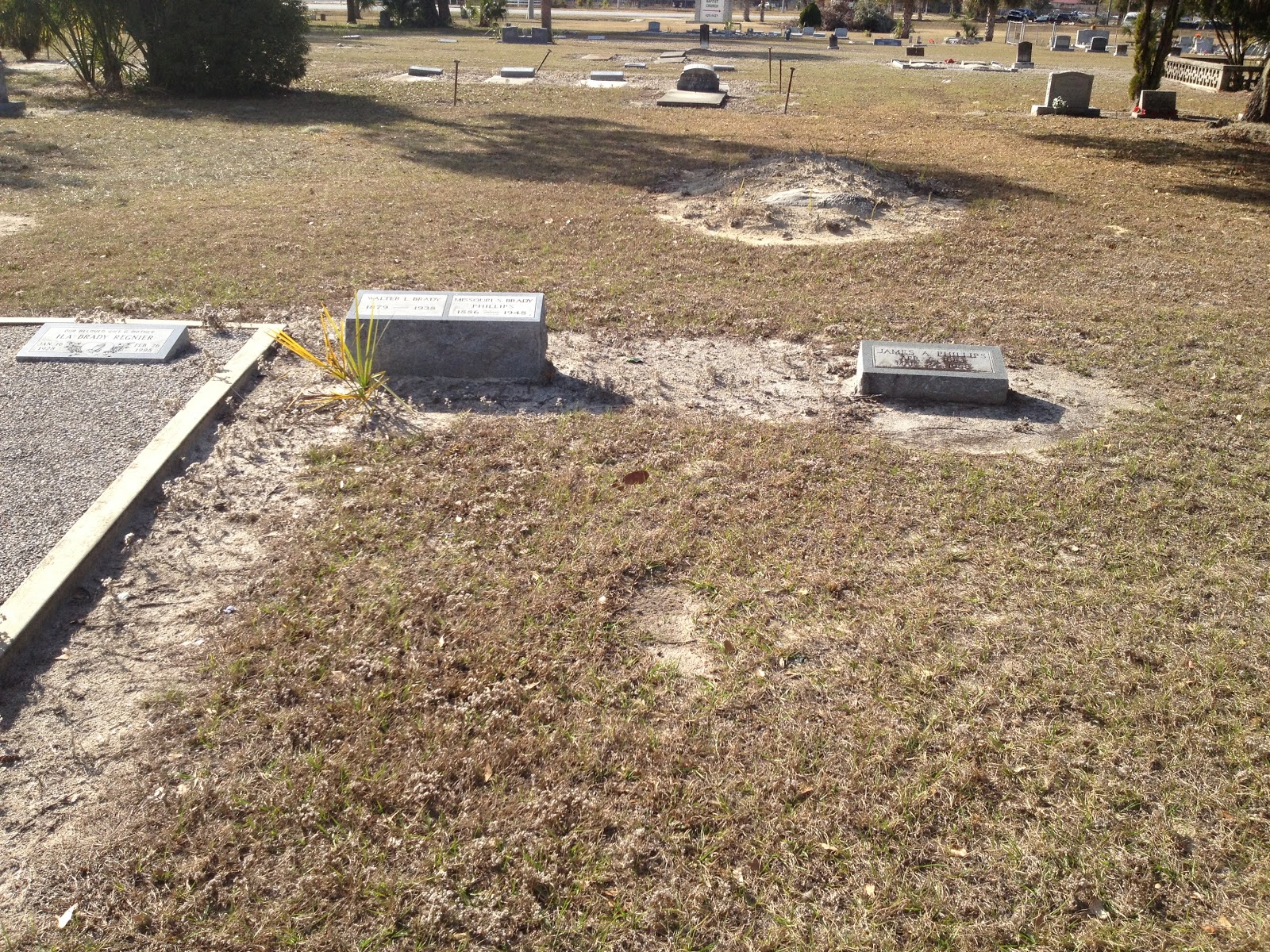
I visited Willow Oak Cemetery this week to see the graves of my Great
Grandparents Missouri Bryan (Bryant) John Brady and James Phillips. No one was around
when I visited.
The three grave sites. Phillips is to the right, Missouri in the middle.
Their son Frank
Ila Mae
Frank and Ila Mae
James Died 10 years later, so his stone is separate.
Walter and Missouri
Updated:
Here is Ila Mae's Obit:
Ila Brady
PIPER CITY - Ila Mae Brady, 70, of Piper City, died Thursday (Feb. 26, 1998) at Gibson City Hospital emergency room.
There will be no visitation.
Services will be held Tuesday in Mulberry, Fla.
Burial will be in Willow Oak Cemetery, Mulberry, Fla.
Arrangements are by the Knapp Funeral Home, Clifton.
She was born Jan. 16, 1928, in Bowling Green, Fla., the daughter of Frank and Claudia Barefoot Best.
Her first husband, Frank Brady, whom she married in 1948, in Miami, Fla., died in May 1978.
Surviving are her husband, Bernard Regnier, of Piper City, whom she married in 1988 in Florida; two daughters, Sarah Krell of Ocala, Fla., Peggy Youmans of Mulberry, Fla.; two sons, Frank Brady Jr. of Oak Harbour, Wash., Walter Brady of Frankfort; one sister, Edna Mae Bosarge of Theodore, Ala.; one brother, Robert Biddle of Olive Branch, Miss.; and 10 grandchildren.
Deceased are her parents and one brother.
She was a member of the Missionary Baptist Church, Mulberry, Fla.
The three grave sites. Phillips is to the right, Missouri in the middle.
Their son Frank
Ila Mae
Frank and Ila Mae
James Died 10 years later, so his stone is separate.
Walter and Missouri
Updated:
Here is Ila Mae's Obit:
Ila Brady
PIPER CITY - Ila Mae Brady, 70, of Piper City, died Thursday (Feb. 26, 1998) at Gibson City Hospital emergency room.
There will be no visitation.
Services will be held Tuesday in Mulberry, Fla.
Burial will be in Willow Oak Cemetery, Mulberry, Fla.
Arrangements are by the Knapp Funeral Home, Clifton.
She was born Jan. 16, 1928, in Bowling Green, Fla., the daughter of Frank and Claudia Barefoot Best.
Her first husband, Frank Brady, whom she married in 1948, in Miami, Fla., died in May 1978.
Surviving are her husband, Bernard Regnier, of Piper City, whom she married in 1988 in Florida; two daughters, Sarah Krell of Ocala, Fla., Peggy Youmans of Mulberry, Fla.; two sons, Frank Brady Jr. of Oak Harbour, Wash., Walter Brady of Frankfort; one sister, Edna Mae Bosarge of Theodore, Ala.; one brother, Robert Biddle of Olive Branch, Miss.; and 10 grandchildren.
Deceased are her parents and one brother.
She was a member of the Missionary Baptist Church, Mulberry, Fla.
Sallie C. Allen Confederate pension application
In 1902 my 3rd great grandmother Sallie C. Allen applied
for a Confederate pension. Her husband James Thomas Allen was a member
of the 18th Texas Cavalry, Company "B" of the Confederate Army, also
known as Darnell's Regiment. She was denied. I requested a copy of the
pension application from the state of Texas.
Subscribe to:
Posts (Atom)